

Choosing the right DAM platform is rarely straightforward – especially if you’re managing rich media, video, and complex org structures.
I recently decided to take a closer look at Orange Logic’s DAM platform and completed their official Foundations of OrangeDAM certification. This article shares my perspective on how OrangeDAM compares to other platforms I’ve worked with, what stood out during the certification, and where it fits best in the DAM landscape.
Why I explored OrangeDAM
OrangeDAM has gained visibility in industries that manage large-scale media broadcast, museums, archives, and complex marketing organizations. I wanted to understand what sets it apart and how it supports enterprise content and creative operations.
The certification process was hands-on and centered around real-world use cases. It had great instructional articles and videos, easy-to-follow practice tasks, and assessment quizzes to validate knowledge progress. But it was also challenging enough to not feel like a formality – the course gave me a lot of value in understanding how the platform works and how real-world use cases can be mapped to it. It confirmed something experienced DAM practitioners often look for but rarely find: true flexibility without giving up control.
5 things that differentiate OrangeDAM
Here are the five capabilities that stood out most during my certification and hands-on use:
1. Governance at scale
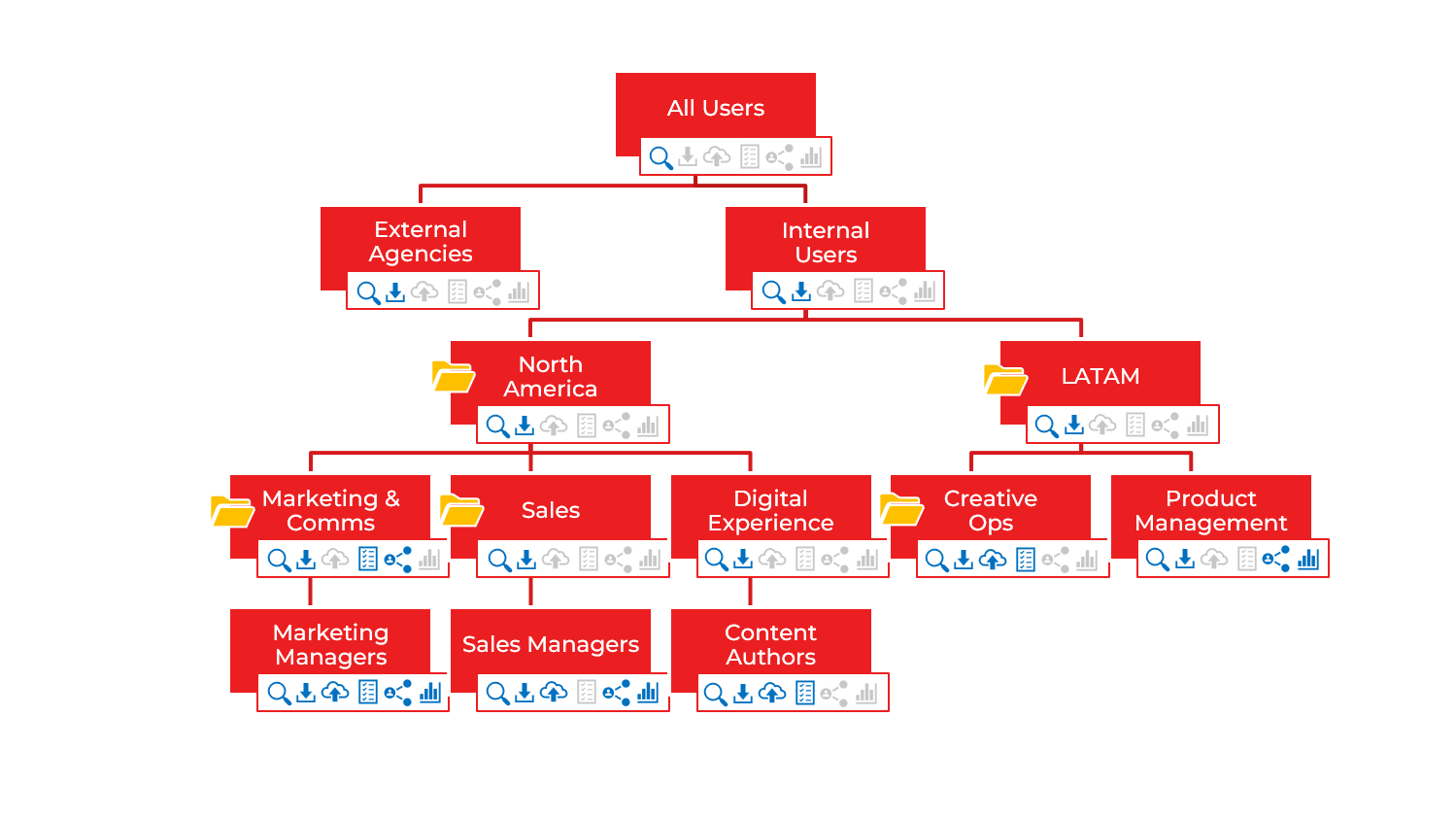
OrangeDAM’s hierarchical user group permissions model allows organizations to reflect their real-world structures and assign inherited permissions and functions across teams, departments, and roles. Folder-level permissions and metadata inheritance are deeply integrated and give administrators full control without the overhead of managing individual exceptions.
For example, a global brand might create a parent group called “Internal Users” with shared permissions and security functions. Regional groups like “North America” or “LATAM” can be set as child groups. These child groups inherit all permissions and restrictions from the parent group, removing the need to configure the same settings across multiple teams.
In addition, folder-level permissions assigned to the parent group not only cascade down to child groups but also propagate through the folder hierarchy. Because all security functions and permissions are cumulative, the highest level of access granted across multiple groups will apply, ensuring flexibility without risking under-permissioning.
This governance model scales very efficiently across complex organizational models, brands, business units, and markets.
2. Cloud-agnostic storage and extreme scalability
OrangeDAM supports true cloud-agnostic deployment. Unlike many DAM platforms that tie you to a single infrastructure, OrangeDAM allows you to choose between AWS, Azure, or Google Cloud for your asset storage – based on what best fits your IT policies, data residency requirements, or long-term strategic goals.

This cloud-agnostic model allows organizations to align asset storage with their existing cloud strategy and avoid vendor lock-in. It also ensures that your infrastructure can adapt as technologies evolve, protecting long-term access and compliance.
OrangeDAM is built to scale. It handles petabytes of content – video, high-resolution imagery, 3D files – with consistent performance.
If your organization works with high-volume media libraries, this kind of scale and infrastructure freedom is essential.
3. Video-first workflows and Media Asset Management (MAM)
OrangeDAM stands out in how it handles video. It doesn’t treat video like just another asset type, it supports it with a robust, end-to-end MAM framework.
This includes:
- Handling raw video in-progress to final production by auto-syncing with Adobe Premiere Pro or Final Cut
- Ingest and upload of large video files
- Versioning and format management
- Frame-accurate review and annotation tools
- Automated transcoding and preview generation
- Approval workflows and delivery tools
This is one of the few platforms that supports native video production workflows from start to finish.
Creative and technical teams can collaborate directly within the platform, ensuring content is reviewed, approved, and distributed efficiently. These capabilities are natively integrated, no need for custom video modules or external MAM systems.
4. Smart automation with AI
OrangeDAM brings AI features into the product in ways that are practical and workflow-focused:
- OrangeAI automates metadata tagging
- Natural Language Processing (NLP) enhances search precision and intent detection
- GenAI capabilities allow for editing, enrichment, templating, and automatic adaptations
- Color-based and similarity search enables intelligent results based on asset colors and visual similarity
- Facial recognition applies rights based on who’s in the frame
AI in OrangeDAM isn’t experimental, it’s embedded in daily workflows.
Beyond AI, OrangeDAM also offers a flexible semantic data model. This allows assets to be linked to people, campaigns, business units, or locations, creating meaningful relationships across your content that enhance discoverability and governance.
5. Flexible deployment options and interoperability
OrangeDAM supports both cloud-based and on-premise deployments, giving enterprises flexibility around data residency, compliance, and infrastructure strategy.
It also adheres to interoperability standards like IIIF (International Image Interoperability Framework), which is especially important for museums, universities, and archives managing large image libraries across platforms.
This open, standards-based approach makes it easier to integrate OrangeDAM into complex ecosystems.
Implementation and adoption of OrangeDAM
With great flexibility and feature-richness comes complexity. OrangeDAM is a powerful platform, but it has a steep learning curve. Its full potential is only realized when users and teams are properly onboarded, and role-based workflows and workspaces are thoughtfully implemented.
Organizations benefit most when they:
- Define a structured metadata model and governance framework
- Customize the UI with role-specific workflows and workspaces
- Provide tailored training and onboarding by user role
- Support change management with internal champions
Without a plan for adoption and support, users may feel overwhelmed and underuse the platform. But with the right guidance, OrangeDAM becomes a strategic asset.
Supporting end-to-end content and creative operations workflows
OrangeDAM excels at managing the entire creative content lifecycle, from ideation and planning, through production and collaboration, to final distribution and archival, within a single platform.
Here’s how a typical creative workflow might look in OrangeDAM:
- A marketing or brand team starts by planning a campaign and uploading a creative brief
- Designers and videographers begin working with creative tools like Adobe Creative Suite, syncing raw files and in-progress assets directly into OrangeDAM
- As assets are created, internal stakeholders and external contributors can review, annotate, and provide feedback using real-time collaboration tools
- Legal and brand teams join the workflow for structured approvals with tracked revisions and version history
- Approved content is automatically transcoded and delivered to downstream systems like CMS platforms, campaign tools, or social media channels
- Rights-managed assets are archived with full metadata, usage rights, and historical context for future reuse or reference
This fully connected process eliminates the need for disconnected tools and email-driven reviews. It speeds up turnaround times, improves compliance, and enhances visibility across content and creative operations.
Who should consider OrangeDAM
OrangeDAM is particularly well-suited for:
- Enterprises with large volumes of complex multimedia content
- Organizations that manage content across multiple brands, markets, or teams
- Media companies, museums, and public institutions with archival or regulated content
- Creative operations teams producing high volumes of video or marketing content
It may be too heavy for smaller teams with lightweight DAM needs, or those seeking a one-size-fits-all, plug-and-play asset library. But for enterprise-grade use cases requiring scale, control, and media depth, OrangeDAM is a compelling option.
Final thoughts
OrangeDAM isn’t just a digital asset library. It’s a mature, highly scalable content operations platform that combines flexibility, governance, and performance.
The learning curve is real, but so is the long-term value.
For organizations willing to invest in thoughtful strategy, implementation and adoption, OrangeDAM can unify teams, streamline creative workflows, and support a future-proof content strategy.

